Hamza SajidAgentic AI EngineerForward-Deployed EngineeringPakistan
Agentic AI / systems / orchestration
From AI capability to work that gets done.
I engineer reliable AI systems that turn real operational workflows into governed AI Workers—combining context, skills, tools, orchestration, and human judgment to move AI from prototype to dependable execution.
A reliable AI system does not jump from a prompt to an action.
It starts with a real job to be done. The work is specified, the right knowledge and context are made available, reusable skills shape how the work is performed, and governed tools connect the worker to real systems. The result is executed under clear boundaries, then verified against the outcome that actually matters.
01 / controlled lifecycle
Specify
Define the job before automating it: the outcome, constraints, inputs, owner, responsibilities, and what “done” actually means.
Value createdThe worker begins with a defined job instead of an ambiguous prompt.
Engineering focus
Outcome, constraints, inputs, ownership, responsibilities, and definition of done.
I engineer AI systems around a real job to be done: define the outcome, encode the right context and capabilities, give agents controlled room to act, and keep humans responsible for the decisions that matter.
01Specify before you automate
02Engineer the harness, not just the agent
03Govern the execution
04Judge the outcome
Specify the work → orchestrate the intelligence → verify the outcome → improve the system.
Good agentic engineering does not begin with a model or a prompt. It begins with the work: understanding who owns the problem, where the friction lives, how often it occurs, what it costs, and what a successful outcome looks like.
I connect problem discovery, domain knowledge, specification, agent architecture, harness engineering, and deployment so AI becomes a dependable part of the workflow—not another prototype sitting beside it.
Designed for
Real problems, measurable outcomes, controlled execution, and systems that get better through use.
01
Problem discovery
I start before the architecture. I map the market, identify the ICP, understand the people involved, study the workflow, and locate the recurring points of friction.
I engineerMarket structure · ICP · Personas · Workflow maps · Pain points · Pain frequency · Pain duration · Operational cost · Existing solutions · Decision points
Value createdFinds the work that is actually worth engineering before technology becomes the answer.
02
Workflow & specification
A vague request is not an engineering specification. I turn the real job into a defined outcome: inputs, constraints, responsibilities, rules, expected outputs, edge cases, and a clear definition of done.
I engineerJob specifications · Workflow decomposition · Acceptance criteria · Decision boundaries · Human responsibilities · Verifiable outputs
Value createdTurns business intent into work an AI system can actually execute and be judged against.
03
Domain intelligence
Reliable AI needs more than model knowledge. I structure the domain knowledge, procedures, rules, and operational expertise a worker needs to perform its role.
I engineerSystems of Record · Systems of Context · Domain knowledge · Reusable skills · Procedures · Rules · Organizational memory
Value createdTurns scattered expertise into reusable intelligence that a worker can access when the job requires it.
04
Agent systems
I design agents around the job—not around the model. The system determines what needs reasoning, what can be delegated, what should use a skill, and where human judgment remains necessary.
Value createdMoves AI from answering questions to performing structured work toward a defined outcome.
05
Agent harness engineering
The model is only one part of the system. I engineer the layer around it that determines what the agent knows, what it can do, what it cannot do, how its work is verified, and what happens when something goes wrong.
Value createdMakes the same intelligence more controllable, inspectable, recoverable, and reliable in real operating conditions.
06
Orchestration
Real work rarely fits inside one model call. I design the execution layer that coordinates skills, agents, tools, state, dependencies, and human gates across a workflow.
I engineerRouting · State · Multi-agent coordination · Durable workflows · Checkpoints · Human gates · Execution loops
Value createdKeeps complex work coherent, recoverable, and visible from beginning to end.
07
Evaluation & reliability
A plausible answer is not proof of a successful system. I design the checks that determine whether the work was actually done correctly—and turn failures into improvements to the system.
Value createdTurns every run into evidence and every meaningful failure into an opportunity to strengthen the system.
08
Deployment & productization
The system matters only when it survives contact with the real workflow. I connect the worker to the systems where work happens, deploy it into its operating environment, and refine it around real usage and measurable outcomes.
I engineerAPIs · MCP · SaaS integrations · Data systems · Production infrastructure · Operational interfaces · Human review surfaces
Value createdMoves AI from prototype to a dependable capability people can actually use.
Understand the work → specify the job → encode the domain → engineer the worker → govern the execution → deploy → judge the outcome → improve.
System architecture / 03
Intelligence is only one layer of the system.
A production AI system gives intelligence the context, capabilities, constraints, and feedback it needs to do useful work.
Human / business intent
Outcome & scopeWhat must be done? What must not happen?
System of contextCorpus · Map · Reflexes · State · Rules · Memory
Agent / harnessReason · Plan · Route · Skills · Policies · State
Learn & promoteImprove the worker · Improve the system · Reuse what repeats
Selected work / 04
Systems that turn operational friction into reliable momentum.
These case studies show how I approach a real operational problem: locate the point of friction, design the smallest dependable system around it, and keep important actions visible to the people responsible for the result.
Inside each case study
Operational friction / system design / value created
01Agentic data operationsCase study
Agentic data operations
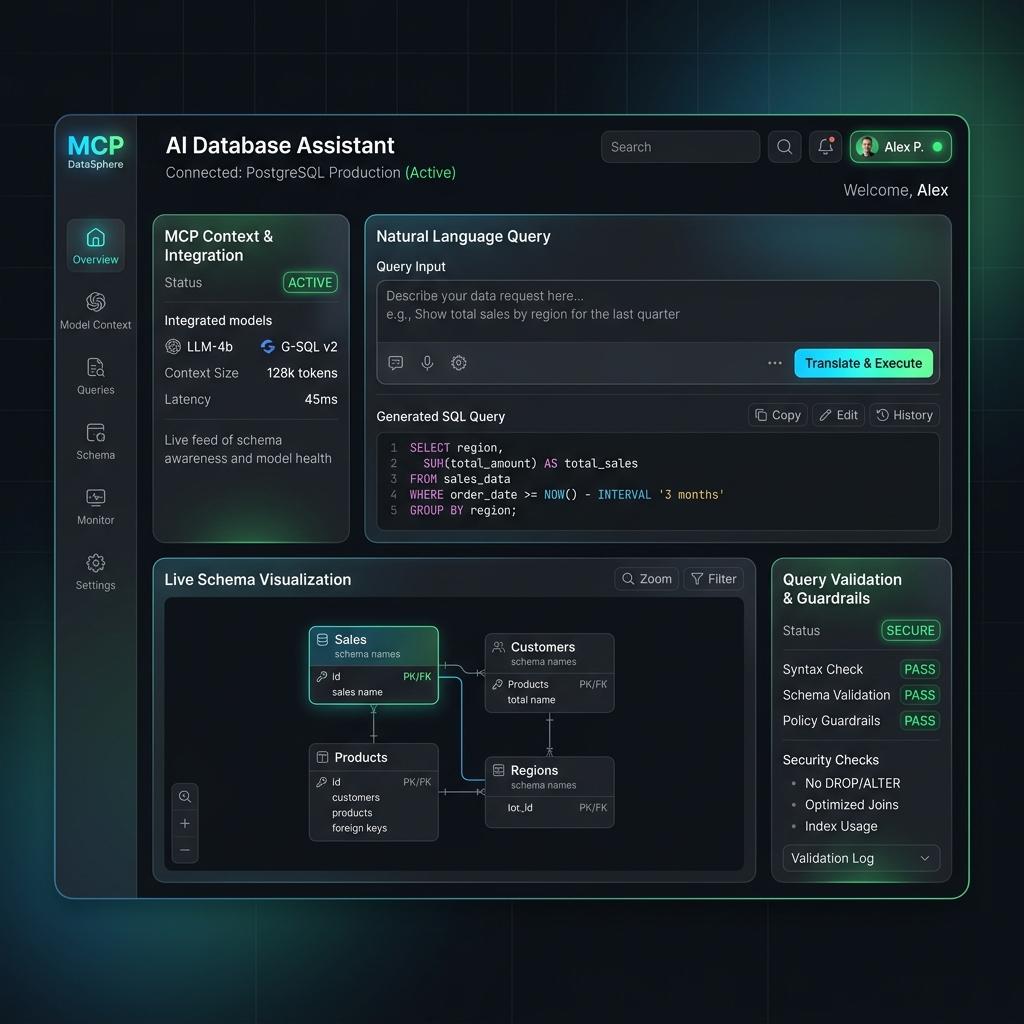
AI Database Assistant
Friction
Database work was trapped behind specialist queries and approval loops.
System design
A permission-aware agent that translates intent into inspectable database actions.
Value created
Natural-language analysis without surrendering control.
Writing is where I turn engineering decisions into useful patterns: agent architecture, controlled autonomy, dependable workflows, and interfaces people can understand and trust.