Agentic data operations
AI Database Assistant
A permission-aware AI Worker that turns business questions into inspectable database analysis.
01 / System briefMCP · FastAPI · PostgreSQL
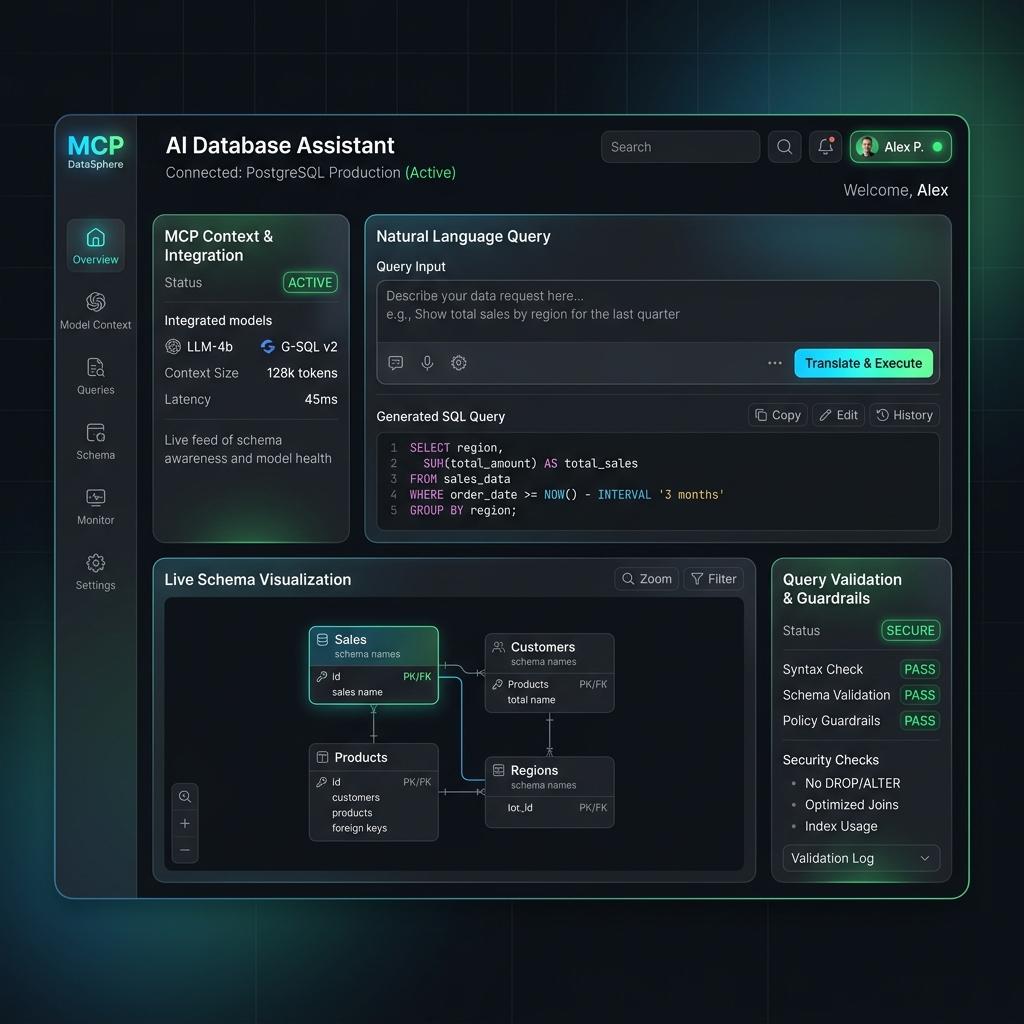 Operational system / 01
01The opportunity
Start with the work that is painful enough to change.
Database analysis was trapped behind specialist queries and approval loops, slowing the route from a business question to evidence.
Event-driven whenever a decision needs evidence from operational data.
The analyst must translate a business question, find the right specialist, wait for a query, and interpret the result.
Slow decisions, repeated handoffs, and limited visibility into how an answer was produced.
02The work, redesigned
From a fragmented handoff to a controlled operating path.
Before
- 01Business request
- 02Specialist handoff
- 03Manual query design
- 04Result review
- 05Decision
After
- 01Business intent
- 02Context assembly
- 03Governed AI Worker
- 04Verified query
- 05Evidence + review
03The specification
Make the job, constraints, and definition of done explicit.
Investigate a permitted data question and return a concise, evidence-backed analysis.
- Business question
- User role and permissions
- Relevant schema and business definitions
A traceable answer with the approved query path, result evidence, and any escalation required.
The request is authorized, the selected operation is safe, execution succeeds, and the answer is grounded in returned data.
Why AI belongs here
The work begins with ambiguous business language, requires schema-aware investigation, and needs the system to choose the next safe read operation based on intermediate evidence.
What stays deterministic
Authorization, query validation, row limits, execution policy, and the final evidence trail remain deterministic software responsibilities.
04The operating system
A worker is more than a model response.
01Request specification
02Schema and policy context
03AI Worker
04Approved MCP tools
05Validation
06Human outcome
Interpret the question, assemble only the relevant data context, propose a bounded read operation, and explain the evidence returned.
- Classify the request
- Inspect permitted schema context
- Plan a read-only operation
- Present evidence and uncertainty
- User permission scope
- Query policy
- Business glossary
- Relevant tables and fields
- Approved schema metadata
- Prior workflow state when available
ToolPurposePermissionBoundary
Schema inspector
Understand allowed data structure
Read-onlyOnly approved metadata
Query executor
Run a validated analysis query
RestrictedRead-only, scoped, and limited
Evidence formatter
Return an inspectable finding
Output onlyNo database writes
05Controlled autonomy
Give the system room to reason. Keep the consequences governed.
Permission-aware routing
The worker receives a constrained tool surface based on the requester's allowed scope.
Validated operations
The model proposes; typed validation and execution policy decide what can run.
Escalation over guessing
Missing context, unsafe intent, or ambiguous results become review points rather than fabricated answers.
06Proof and iteration
Make the system inspectable before asking people to trust it.
- Request classification
- Selected context
- Proposed operation
- Validation result
- Execution status
- Correct tool selection
- Permission compliance
- Query safety
- Evidence-grounded response
- Clear escalation
Tool access is not the bottleneck by itself; the worker needs the right business definitions and schema context before it can make a useful plan.
Promote recurring investigation patterns into reusable skills and add scenario-based evaluations for ambiguous analyst requests.
Intended outcome
Natural-language analysis without surrendering control.
This system briedev.hamzasajid@gmail.comonal design: the work to improve, the boundaries that keep it safe, and the evidence needed to operate it responsibly. It does not claim unmeasured benchmarks.
Discuss a similar system