Engineering journal / 2026
Notes from
inside the system.
Writing on agent architecture, software systems, and the engineering decisions that make intelligence useful.
12 field notes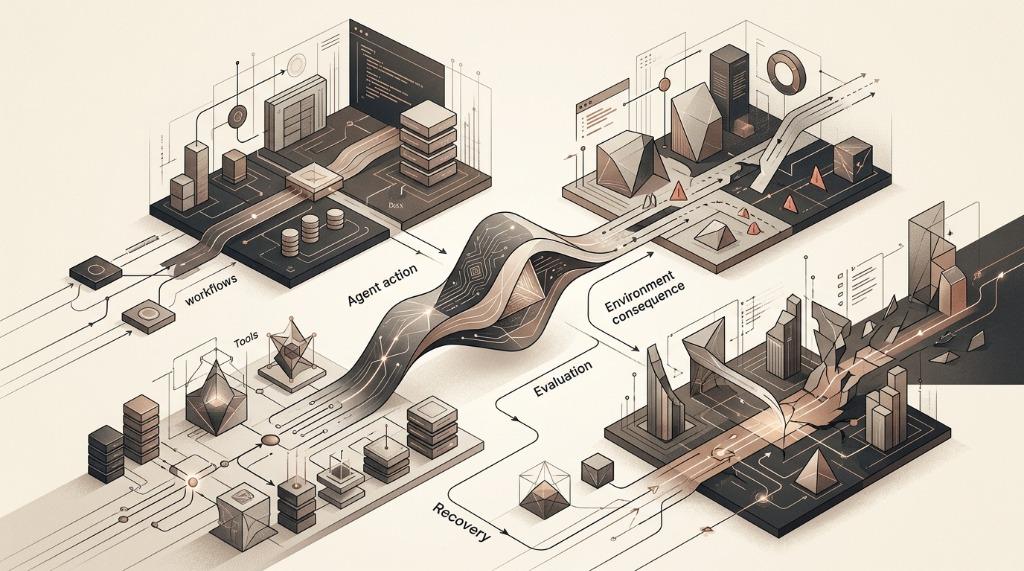
Agentic Engineering — Sep 13, 2026
AI Agents Need Test Worlds, Not Test Cases: The 2026 Blueprint for Executable Agent Simulation Layers
Why traditional unit tests fail autonomous systems. A comprehensive architectural deep dive into executable synthetic environments, digital twins, state-grounded trajectories, and failure injection frameworks.
Read the note
Identity & Architecture — Feb 22, 2026
The Architect's Origin: Foundations, Learning, and the Path to Mastery
A comprehensive narrative exploring the fusion of personal identity, academic rigor, and the technical awakening that defines my engineering philosophy.
Read field note
AI Engineering — Sep 03, 2026
FDE Is Building Future-Driven Workforces.
Equipping people and systems for the future of work. The comprehensive 2026 engineering blueprint for Forward Deployed Engineering (FDE) in AI—how embedded engineers bridge domain experts, legacy systems, and autonomous agent swarms.
Read field noteAgentic Architecture / 24 min
Standardized Interoperability Is Connecting Every Digital FTE.
How open protocols, Model Context Protocol (MCP), SKILL.md procedures, and Agent-to-Agent (A2A) message buses unite isolated AI workers into scalable, enterprise-grade autonomous swarms.
05Enterprise AI / 22 min
Enterprise Agents Are Building The Workforce.
From tools for tasks to a system of record. The definitive 2026 technical analysis of how enterprise AI agents transition from stateless task tools into durable, persistent systems of record.
06AI / 25 min
The Vertical AI Employee: Building the Future of Domain-Specific Autonomous Agents
The definitive 2026 blueprint for building persistent, secure, and domain-specialized AI employees. A deep dive into the Body+Brain architecture, Agent Skills, and MCP standards.
07Engineering / 20 min
Agents Building Agents: The Recursive Power of Claude Code
Exploring the shift from manual coding to meta-tooling. How Claude Code enables a recursive development loop where AI agents autonomously build, secure, and extend enterprise-grade Vertical AI Employees.
08Agent Architecture / 18 min
Designing Systems Around Models, Not Demos: The AI Agent Factory Blueprint for Production AI Workers
The Third Era of AI is not about better chatbots—it's about Digital FTEs. Learn how the Agent Factory's spec-driven methodology, Four Layers architecture, and Job-to-be-Done framework transform models into reliable AI Workers with verified outcomes.
09Harness Engineering / 20 min
The Agent Harness: Agent Factory's Blueprint for the Runtime that Makes AI Workers Controllable and Useful
The model is 10% of an AI Worker. The Agent Factory framework's harness engineering—covering MCP sandboxes, loop engineering, state checkpointing, OpenClaw, and Hermes—is the 90% that makes agents reliable in production.
10Context Engineering / 17 min
Context Engineering: The Agent Factory's System of Context, SKILL.md Pattern, and AI-Searchable Knowledge Architecture
The AI Agent Factory distinguishes between Systems of Record (where facts live) and Systems of Context (how an AI Worker reasons about them). Learn to build the five-layer context architecture with Neon Postgres, pgvector, and SKILL.md procedures.
11Deterministic AI / 19 min
Deterministic AI: The Agent Factory's Spec-Driven Development, State Machines, and require_approval Architecture
The AI Agent Factory's Spec-Driven Development methodology pairs non-deterministic LLM reasoning with deterministic state machines, typed output contracts, idempotent tool calls, and the require_approval human gate for zero-hallucination enterprise workflows.
12AI Reliability / 22 min
AI Reliability Engineering: The Agent Factory's Eval-Driven Development, Maker-Checker Pattern, and 'Leaving the Laptop' Standard
The AI Agent Factory's Eval-Driven Development methodology, Maker-Checker pattern, distributed tracing, and the 'Leaving the Laptop' standard define what it means to build AI Workers that humans can genuinely trust.