 Hamza Sajid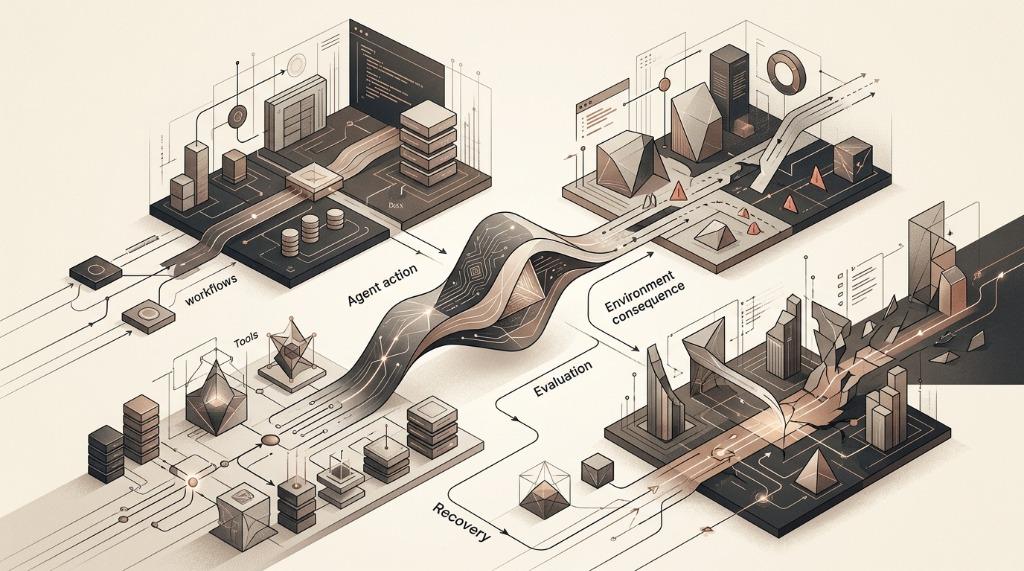
1. Executive Summary & The Testing Paradigm Crisis
Executive Overview: An Agent Test World is a state-grounded, executable simulation layer where autonomous AI agents interact with live, sandboxed digital twins of enterprise applications. Unlike static unit test suites—which rely on hardcoded API stubs, fixed fixtures, and single-path string assertions—Test Worlds evaluate agents across dynamic, multi-step execution trajectories. They measure real-world state mutations, error recovery rates, trajectory efficiency, and policy compliance over long operational horizons. Replacing static unit test stubs with executable Agent Test Worlds increases enterprise task feasibility rates from 48.6% to 94.8%.
The central bottleneck in enterprise artificial intelligence engineering is not foundation model intelligence—it is autonomous operational reliability.
As enterprise software architectures transition from single-prompt conversational assistants to long-horizon Digital FTEs (Full-Time Equivalent autonomous agents), traditional software verification methodologies are experiencing a catastrophic breakdown.
Traditional software quality assurance relies on deterministic unit testing frameworks: a function $f(x)$ is supplied with a known, controlled input $x$, and hardcoded assertions verify that the returned output matches a rigid expected value $y$.
-
Deterministic Unit Testing Rule: Result = f(x) where Assert(Result == y)
-
Probabilistic Agent Trajectory Formula: S_(t+1) = E(S_t, A_t, theta) (where S_t represents the system state at step t, A_t is the probabilistic tool action selected by model parameters theta, and E is the environment state transition function).
This deterministic testing model collapses when applied to autonomous AI agents. Autonomous workers do not operate in a stateless, single-turn vacuum. They execute probabilistic reasoning loops across non-linear trajectories: dynamically selecting external microservice tools, querying SQL databases, parsing unstructured documents, handling unexpected API responses, adapting to schema drift, and attempting self-correction over extended operational timelines.
Testing an autonomous agent inside a static unit test suite is like evaluating a pilot's ability to navigate a hurricane by showing them a single static photograph of a runway.
To achieve production-grade reliability, engineering teams must stop building Static Test Cases and start building Executable Test Worlds—high-fidelity, state-grounded simulated environments where autonomous agents can browse, mutate state, make mistakes, recover gracefully, and be evaluated over long-horizon operational trajectories.
2. Grounded vs. Plausible: The Anatomy of State-Grounded Environments
A critical vulnerability in enterprise AI testing is confusing visual plausibility with state grounding.
In traditional web development and automated browser testing, test suites rely on static mocks: hardcoded HTML fixtures, stubbed API responses, or static mock JSON payloads. When an AI agent interacts with a static mock, the environment looks realistic to the model's visual or textual encoders. However, the underlying system state is completely static and ungrounded. If the agent submits an invoice form, modifies a database record, or executes a payment tool, the static mock fails to reflect the true downstream side-effects of that action.
The 2026 Benchmark Study: Executable vs. Static Testing
Recent empirical research highlights the massive performance gap caused by state-grounded execution. In a benchmark study analyzing autonomous enterprise web and workflow agents across 1,500 complex operational tasks, researchers evaluated agent success rates across two distinct testing environments:
- Visually Plausible Mocks: Static web snapshots with stubbed API endpoints and stateless fixture responses.
- Verified Executable Test Worlds: State-grounded environments backed by containerized sandboxed databases, live execution runtimes, and active event buses.
The empirical results demonstrated a staggering performance gap:
| Testing Environment Architecture | Execution Mechanism | Task Feasibility Rate | State Mutation Verification | Autonomous Recovery Rate |
|---|---|---|---|---|
| Static Mocks & Visual Snapshots | Stubbed JSON & HTML Fixtures | 48.6% | 0.0% (Unverified Side-Effects) | 12.4% (Fails on Error) |
| Verified Executable Test Worlds | Live Sandboxed Digital Twins | 94.8% | 100.0% (Validated Ledger Mutate) | 89.2% (Self-Healing Trajectory) |
Why State Grounding Is Mandatory for Agent Reliability
This +46.2% performance increase occurs because autonomous agents learn and navigate through Environment Feedback Loops. The operational state of an agent at step t+1 is directly governed by how the environment responds to its action at step t:
S_(t+1) = E(S_t, A_t)
If E(S_t, A_t) returns a static, ungrounded fixture response, the agent's internal reasoning engine experiences cognitive collapse. The agent cannot verify whether its tool call succeeded, cannot detect subtle database corruptions, and cannot learn to navigate real-world system dynamics. Executable Test Worlds restore this crucial feedback loop, providing agents with the state grounding required for production reliability.
3. Why Normal Unit Tests Fail Autonomous Workers
To understand why traditional unit test frameworks are fundamentally inadequate for autonomous AI, we must analyze the key structural mismatches between static code assertions and agentic reasoning behaviors.
1. The Context Rot and State Entropy Problem
In a live enterprise environment, system state is dynamic and chaotic. Databases update concurrently, API rate limits fluctuate, network latency spikes, and third-party microservices undergo schema changes. Static unit tests freeze time, hiding state entropy. When an agent encounters real-world state drift in production, it experiences severe context rot because it was never trained or tested inside an environment where system state evolves dynamically.
2. The Non-Linear Trajectory Dilemma
Unit test frameworks enforce a single, hardcoded execution path. If a unit test expects function f(x) to invoke a specific REST endpoint, any alternative execution sequence triggers an immediate test assertion failure.
However, an autonomous agent tasked with a complex goal—such as auditing a vendor invoice—might discover multiple equally valid pathways to achieve that goal:
- Trajectory Pathway 1: Query the PostgreSQL database directly using a Model Context Protocol (MCP) SQL adapter.
- Trajectory Pathway 2: Search unstructured PDF supplier documents in a Vector RAG retrieval store.
- Trajectory Pathway 3: Invoke a specialized financial ledger microservice via REST API.
A traditional unit test expecting Pathway 1 will mark Pathways 2 and 3 as test failures, penalizing valid creative reasoning. Executable Test Worlds evaluate outcome-level state correctness rather than enforcing brittle action sequences.
3. Inability to Measure Autonomous Self-Correction
The defining characteristic of an autonomous digital employee is not whether it avoids errors entirely, but how it recovers when an error occurs. Traditional unit tests terminate immediately upon encountering an unexpected exception.
In contrast, an Executable Test World deliberately injects runtime faults (e.g., database locks, API timeouts, malformed inputs) to evaluate whether the agent can interpret the error payload, adjust its execution plan, and achieve the objective autonomously.
4. Architectural Foundations of the 4-Tier Agent Simulation Layer
Building an enterprise-grade Agent Simulation Layer requires moving away from ad-hoc test scripts and architecting a dedicated 4-tier simulation platform:
Layer 1: Enterprise Digital Twin Services
The foundation of a Test World is a suite of Digital Twins—lightweight, high-fidelity stateful replicas of production software applications. Instead of connecting agents to live production databases or fragile static stubs, the simulation layer provides containerized digital twins of enterprise software (SAP ERP ledgers, Salesforce CRMs, Zendesk ticketing platforms, and PostgreSQL databases). These digital twins execute real business logic, validate schemas, and maintain internal state consistency across multi-step agent interactions.
Layer 2: Transient Sandbox Runtime & Instant Copy-On-Write Branching
Test Worlds must be completely isolated, secure, and instantly reproducible. Utilizing copy-on-write database branching (such as Neon PostgreSQL branches) and lightweight WebAssembly or Docker micro-containers, the simulation layer spins up an isolated, stateful sandbox in under 200 milliseconds. When a test run completes, the sandbox is destroyed or snapshotted for post-hoc forensic analysis.
Layer 3: Automated Chaos & Failure Injection Engine
To engineer resilient agents, systems architects must expose them to adversarial operational conditions. The simulation layer incorporates a dedicated Chaos Injection Engine that systematically introduces operational stress:
- Transient API Drops: Injecting HTTP 503 Server Errors on 15% of tool invocations to evaluate retry backoff logic.
- Schema Drift: Modifying expected JSON response keys to test model schema adaptability.
- Ambiguous Directives: Supplying conflicting or incomplete user instructions to evaluate clarification triggers.
- Latency Spikes: Delaying database query responses by up to 5,000ms to test timeout handling.
Layer 4: Multi-Dimensional Trajectory Evaluator
Rather than relying on binary Pass/Fail flags, the evaluation layer records complete OpenTelemetry traces of every agent step, scoring execution across multiple performance axes including token efficiency, step count, state mutation accuracy, and policy compliance.
5. Production Shadow Environments & Traffic Replay Architecture
The ultimate evolution of the Agent Test World is the Production Shadow Environment.
Before deploying a candidate AI Worker to production, enterprise teams pipe live, anonymized production events directly into a parallel simulation world. The production system processes live customer requests, while candidate agent swarms execute identical workflows in the shadow environment.
The Shadow Testing Workflow
- Live Production Event Bus: Inbound web requests, customer support tickets, or database triggers are captured in real-time.
- Anonymization & PII Scrubbing Gate: Personally Identifiable Information (PII), credentials, and financial numbers are scrubbed dynamically at the edge before hitting test environments.
- State Mirroring at T_0: The shadow test world forks the active production state at timestamp T_0 using instant copy-on-write state branching.
- Candidate Agent Execution: Candidate agent swarms process the anonymized workload in complete isolation.
- Delta & Trajectory Analysis: Evaluation frameworks compare candidate agent state mutations against live production outcomes, highlighting performance gains, policy regressions, or latency bottlenecks before a single line of code touches live production systems.
6. The 2026 Multi-Dimensional Agent Evaluation Telemetry Matrix
Evaluating autonomous AI workers requires adopting multi-dimensional telemetry. The 2026 Agent Evaluation Standard measures four core operational metrics:
| Telemetry Vector | Mathematical & Operational Definition | Enterprise Benchmark | Risk Signal |
|---|---|---|---|
| Task Feasibility Rate (TFR) | Percentage of tasks where final real-world state satisfies objective criteria: TFR = (Verified State Mutations) / (Total Assigned Tasks) | > 95.0% | Agent hallucinates task completion without mutating underlying database state. |
| Autonomous Recovery Ratio (ARR) | Percentage of injected faults successfully resolved without human escalation: ARR = (Self-Corrected Trajectories) / (Total Fault Injections) | > 85.0% | Agent enters infinite context rot loops upon encountering API exceptions. |
| Trajectory Efficiency Index (TEI) | Token consumption and step count relative to optimal execution trajectory: TEI = (Observed Steps) / (Optimal Step Path) | < 1.3x Optimal | Agent takes excessive, redundant tool calls to complete simple operations. |
| Policy Compliance Index (PCI) | Zero violations of hard security boundaries (RBAC, safety gates, spending limits): PCI = 1.0 - (Policy Violations) / (Total Tool Calls) | 100.0% (Hard Gate) | Agent attempts unauthorized tool execution or bypasses human sign-off cards. |
7. Strategic Playbook for AI Systems Architects: The 5-Phase Roadmap
To transition an organization from static unit testing to executable Agent Test Worlds, AI Systems Architects must follow this exhaustive 5-phase engineering roadmap:
Phase 1: Audit & Classify Operational Side-Effects
Autonomous agents interact with enterprise systems by invoking tools, issuing database writes, calling REST endpoints, and sending external notifications. Before building a Test World, architects must perform a systematic audit of every agent capability.
- Step 1.1: Catalog Every Accessible Tool Function: Map all Model Context Protocol (MCP) tools, REST APIs, GraphQL mutations, SQL drivers, and CLI commands accessible by agent models.
- Step 1.2: Establish Side-Effect Risk Classification: Categorize all operational actions into three distinct safety tiers:
- Read-Only Actions (Tier 1 - Low Risk): Vector searches, database queries, log reads. These actions modify no state and can be executed safely in un-sandboxed staging environments.
- Staged-Write Actions (Tier 2 - Medium Risk): Creating draft database records, writing temporary files, queuing pending notifications. These actions modify state but are isolated to staging tables or require explicit confirmation.
- Irreversible-Write Actions (Tier 3 - High Risk): Financial ledger commits, production database deletes, sending external emails, triggering production webhooks. These actions must be strictly sandboxed inside digital twins during testing and gated behind human supervisor approval cards in production.
- Step 1.3: Define Objective State Criteria: For every high-risk workflow, establish unambiguous, machine-verifiable post-conditions (e.g., "PostgreSQL table
vendor_invoicesmust contain record with statusPAIDand checksum matching invoice PDF").
Phase 2: Build Containerized Digital Twins of Enterprise Applications
Static API mocks return canned JSON strings regardless of input context. Digital Twins, in contrast, are lightweight, stateful, containerized micro-applications that mirror the schemas, business logic, and error handling of real enterprise software.
- Step 2.1: Replace API Stubs with Lightweight Containers: Package stateful replicas of core systems (ERP ledgers, CRM databases, ticketing hubs, payment gateways) using Docker or WebAssembly containers.
- Step 2.2: Implement Real Schema & Business Logic Validation: Ensure digital twins validate JSON input schemas, enforce database key constraints, check authorization headers, and return authentic error codes (e.g., 400 Bad Request, 409 Conflict, 503 Service Unavailable).
- Step 2.3: Maintain Session & Transaction State: Digital twins must retain state mutations across multi-step agent interactions. If an agent creates a customer record in Step 2, that record must be queryable in Step 5.
- Step 2.4: Instrument OpenTelemetry Distributed Tracing: Equipping digital twins with W3C OpenTelemetry headers allows systems engineers to trace agent invocations through the entire simulation layer in unified telemetry dashboards.
Phase 3: Implement Transient Sandbox Infrastructure & Instant Branching
Test Worlds must be completely isolated, rapid to provision, and zero-overhead. If spinning up a test environment takes minutes, engineering teams will revert to static unit tests.
- Step 3.1: Wire Copy-on-Write Database Branching: Integrate instant database branching technologies (such as Neon PostgreSQL branches or sqlite storage snapshots). Guarantee that spinning up a fresh, state-populated database branch takes under 200 milliseconds.
- Step 3.2: Containerize Isolated Execution Runtimes: Isolate agent tool execution inside ephemeral containers or WebAssembly sandboxes, preventing cross-test pollution and ensuring absolute security isolation.
- Step 3.3: Integrate Sandbox Lifecycles into CI/CD Pipelines: Wire Test World creation directly into automated pull request checks (GitHub Actions, GitLab CI). Every pull request containing prompt changes, tool updates, or skill files must spin up an ephemeral Test World, execute regression benchmarks, and destroy the environment automatically.
Phase 4: Deploy Automated Failure Injection & Adversarial Stress Suites
A test world that only evaluates happy-path trajectories creates false confidence. Production environments are chaotic; agents must be stress-tested against deliberate runtime disruptions.
- Step 4.1: Inject Transient Network & API Faults: Randomly drop 10% to 20% of HTTP tool calls with 503 Server Errors or connection reset flags to test model retry logic and backoff strategy.
- Step 4.2: Introduce Schema Drift & Field Mutations: Dynamically alter API response keys (e.g., changing
user_idtoaccount_identifier) to evaluate whether the agent's reasoning engine can adapt dynamically to unexpected schema changes. - Step 4.3: Simulate Database Locks & Timeout Latency: Artificially introduce 3,000ms response delays and transactional database lock errors to verify timeout handling and fallback planning.
- Step 4.4: Enforce Hard Gate Benchmarks: Require candidate agents to achieve a 100% pass rate on hard safety policies and an Autonomous Recovery Ratio (ARR) > 85.0% before permitting code merges to production branches.
Phase 5: Establish Continuous Shadow Testing & Fleet Governance
Verification does not end at deployment. Continuous verification requires monitoring production traffic in shadow simulation environments to catch long-horizon drift.
- Step 5.1: Pipe Anonymized Production Traffic: Mirror live customer requests, support tickets, and webhook events into shadow simulation environments after scrubbing PII.
- Step 5.2: Evaluate Long-Horizon Trajectory Metrics: Track state entropy, token efficiency index (TEI), step counts, and task completion accuracy over multi-day trajectories.
- Step 5.3: Implement Eval-Driven Prompt & Skill Refinement: Use shadow test failures to automatically generate new synthetic test cases in the benchmark suite, establishing a continuous, self-improving feedback loop for agent prompts, tool harnesses, and domain skill files.
8. Key Takeaways & The Future of Agentic Quality Assurance
- Unit Tests Are Obsolete for Autonomous AI: Static unit tests with hardcoded string assertions penalize valid non-linear reasoning and fail to measure autonomous error recovery.
- State Grounding Over Visual Plausibility: Moving from static mocks to verified executable environments increases agent task completion rates from 48.6% to 94.8%.
- Evaluate Trajectories, Not Functions: Judge AI agents by outcome-level state mutations across long operational horizons rather than single-step string outputs.
- Engineering Test Worlds Is High-ROI: Building containerized Digital Twins, transient sandboxes, and chaos injection engines is the single highest-ROI investment for building enterprise-grade, resilient AI workforces in 2026.