 Hamza Sajid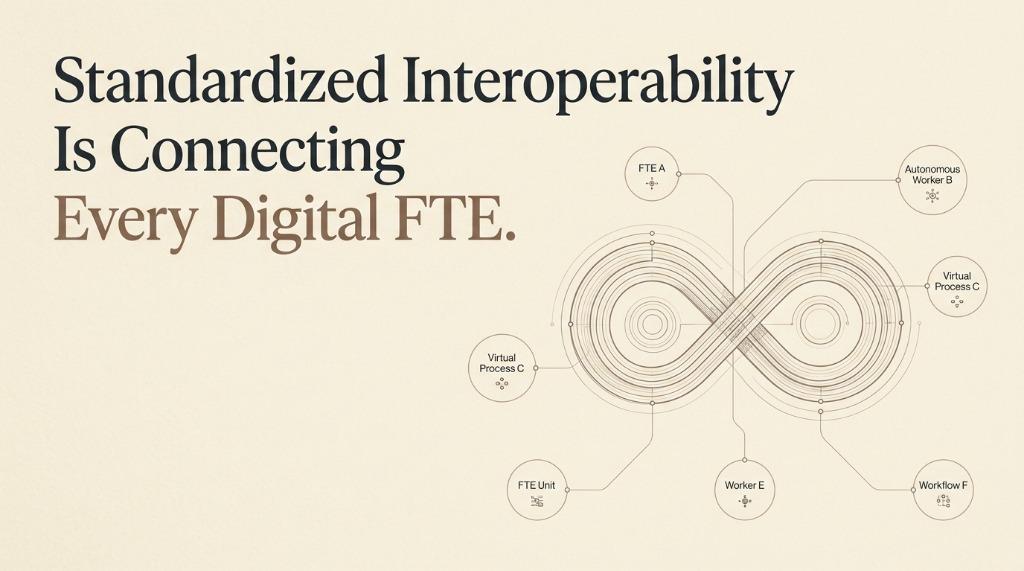
1. Executive Summary: The Multi-Agent Interoperability Frontier
Enterprises are facing a fundamental architectural paradox: The Siloed Agent Crisis.
In 2024 and 2025, forward-thinking organizations deployed specialized AI tools for isolated business functions—an HR recruiter bot in Slack, a customer support agent in Zendesk, a financial ledger reconciler in SAP, and a developer assistant in GitHub. While each isolated bot demonstrated local utility, enterprise workflows broke down at organizational handoffs.
       ISOLATED PROPRIETARY SILOS                    STANDARDIZED INTEROPERABLE SWARM

  |  HR Bot A    |  | Finance Bot B|               |   Digital FTE A <---> FTE B      |
  | (Proprietary |  | (Vendor API  |       vs      |         \             /          |
  |  JSON schema)|  |  Lock-in)    |               |          \           /           |
                   |           Digital FTE C          |
         \                /                        |   (MCP Wire + A2A Event Bus)     |
          x--------------x
        Fragile N×M Adapters                             Zero-Silo Standardized Wire
Connecting N specialized digital workers to M enterprise tools without common standards required N×M custom API wrappers. Every model update broke string-parsed outputs, prompt windows accumulated context rot, and security teams could not audit cross-departmental actions.
In 2026, the breakthrough solution is Standardized Interoperability. By combining open wire standards like the Model Context Protocol (MCP), portable domain procedures (SKILL.md), and unified Agent-to-Agent (A2A) event routing, enterprise organizations are connecting every Digital FTE into a coherent, self-healing autonomous workforce.
2. The Five-Layer Interoperability Protocol Stack
True agent-to-agent interoperability requires a layered protocol stack, analogous to the OSI network model. Skipping any single layer creates integration fragility or security loopholes.
Architectural Topology & Protocol Layers:
-
- Layer 5: OpenTelemetry Observability (Distributed traceparent & step metrics)
- Layer 4: Governance & RBAC (Least-privilege token delegation & approval gates)
- Layer 3: State & Checkpoint Synchronization (Distributed relational event ledger)
- Layer 2: Declarative Skill Procedures (SKILL.md & OpenAPI schema contracts)
- Layer 1: Universal Wire Protocol (Model Context Protocol - MCP over SSE/stdio)
-
Layer 1: Universal Wire Protocol (MCP)
The Model Context Protocol (MCP) acts as the universal wire connecting AI reasoning engines to external systems of record. MCP standardizes tool definitions, context resources, and prompt execution over standardized transports (stdio, Server-Sent Events, or WebSockets).
Layer 2: Declarative Skill Procedures (SKILL.md)
Instead of forcing downstream agents to parse raw unstructured text or hardcoded prompts, operational procedures are defined in declarative SKILL.md specifications. These files specify exact pre-conditions, typed Zod arguments, execution steps, and post-conditions.
Layer 3: State & Checkpoint Synchronization
Multi-agent handoffs require durable state persistence. When FTE A delegates a sub-task to FTE B, the transaction state is persisted to a relational ledger (Neon Postgres + Redis) keyed by a unique workflow_run_id. If execution pauses, any authorized agent node can resume from the last verified checkpoint.
Layer 4: Governance & Least-Privilege RBAC
Interoperability must not compromise security. Agents delegate permissions using scoped OAuth2 bearer tokens, ensuring an HR agent cannot invoke administrative payment tools without explicit escalation policy approval.
Layer 5: Distributed Observability
All inter-agent communications emit W3C-compliant traceparent headers, enabling SREs and compliance officers to trace a multi-agent transaction across dozens of autonomous nodes in a single waterfall trace.
3. The Infinite Loop Architecture for Digital Fleets
In high-throughput enterprise environments, digital workers operate in continuous, self-reinforcing loops. FTE A ingests unstructured input, delegates sub-tasks to Worker B, updates Virtual Process C, triggers FTE Unit D, evaluates results in Worker E, and commits verified changes to Workflow F.
graph LR
    subgraph Swarm Topology
        FTE_A[FTE A: Ingestion Node] -->|MCP Tool Request| Worker_B[Autonomous Worker B: Analysis]
        Worker_B -->|State Checkpoint| Process_C[Virtual Process C: Staging]
        Process_C -->|A2A Event Trigger| FTE_Unit[FTE Unit D: Verification]
        FTE_Unit -->|Maker-Checker Audit| Worker_E[Worker E: Governance Gate]
        Worker_E -->|System of Record Write| Workflow_F[Workflow F: Commit]
    end
This continuous loop requires three architectural guarantees:
- Idempotence: Re-executing an agent transaction must never produce duplicate payments or duplicate database entries.
- Deterministic State Transitions: LLM reasoning handles adaptive logic, but state machine transitions dictate execution order.
- Maker-Checker Isolation: Execution agents (Makers) and auditing agents (Checkers) maintain independent context windows and read/write permission scopes.
4. Code Deep-Dive: Building an Interoperable A2A Message Envelope
To enable seamless inter-agent communication, messages between Digital FTEs are wrapped in standardized, typed message envelopes.
Cross-Agent Envelope Contract (TypeScript & Zod)
import { z } from "zod";

export const A2AMessageEnvelopeSchema = z.object({
  messageId: z.string().uuid(),
  workflowRunId: z.string().uuid(),
  traceparent: z.string().regex(/^00-[a-f0-9]{32}-[a-f0-9]{16}-01$/),
  senderFteId: z.string(),
  recipientFteId: z.string(),
  activeSkill: z.string(),
  payload: z.record(z.any()),
  delegatedPermissions: z.array(z.string()),
  idempotencyKey: z.string(),
  timestamp: z.string().datetime(),
  status: z.enum(["REQUESTED", "IN_PROGRESS", "COMPLETED", "FAILED", "PAUSED_FOR_APPROVAL"]),
});

export type A2AMessageEnvelope = z.infer<typeof A2AMessageEnvelopeSchema>;

// Example: Sender FTE constructing an interoperable sub-task request
export function createSubTaskEnvelope(
  senderId: string,
  recipientId: string,
  skillName: string,
  taskPayload: Record<string, any>,
  runId: string,
  stepIndex: number
): A2AMessageEnvelope {
  return {
    messageId: crypto.randomUUID(),
    workflowRunId: runId,
    traceparent: `00-${runId.replace(/-/g, "")}-1234567890abcdef-01`,
    senderFteId: senderId,
    recipientFteId: recipientId,
    activeSkill: skillName,
    payload: taskPayload,
    delegatedPermissions: ["read:ledger", "write:staging_records"],
    idempotencyKey: `${runId}_step_${stepIndex}_${skillName}`,
    timestamp: new Date().toISOString(),
    status: "REQUESTED",
  };
}
5. Sandboxed MCP Adapter for Cross-Agent Tool Dispatch
In production, agents invoke other agents via sandboxed Model Context Protocol (MCP) server endpoints:
import asyncio
import json
import uuid
from typing import Dict, Any
from pydantic import BaseModel

class A2AToolRequest(BaseModel):
    workflow_run_id: str
    target_agent: str
    action_skill: str
    parameters: Dict[str, Any]
    idempotency_key: str

class InteroperableAgentRouter:
    def __init__(self, mcp_registry_url: str):
        self.registry_url = mcp_registry_url
        self.processed_keys = set()

    async def dispatch_interoperable_call(self, request_data: Dict[str, Any]) -> Dict[str, Any]:
        req = A2AToolRequest(**request_data)

        # 1. Enforce Idempotency Check
        if req.idempotency_key in self.processed_keys:
            return {
                "status": "SKIPPED_DUPLICATE",
                "message": f"Transaction {req.idempotency_key} already processed.",
                "idempotency_key": req.idempotency_key
            }

        # 2. Log Distributed Trace Start
        print(f"[A2A BUS] Dispatching {req.action_skill} to {req.target_agent} (Run: {req.workflow_run_id})")

        # 3. Perform Sandboxed Call over MCP Transport
        result = await self._invoke_mcp_agent_node(req.target_agent, req.action_skill, req.parameters)

        # 4. Record Idempotency Key upon successful dispatch
        self.processed_keys.add(req.idempotency_key)

        return {
            "status": "SUCCESS",
            "result": result,
            "idempotency_key": req.idempotency_key
        }

    async def _invoke_mcp_agent_node(self, target: str, skill: str, params: Dict[str, Any]) -> Dict[str, Any]:
        # Simulated Sandboxed MCP JSON-RPC 2.0 Call
        await asyncio.sleep(0.05)
        return {"output": f"Executed {skill} on node {target}", "evidence_hash": "sha256_e3b0c44298fc1c149afbf4c8996fb92427ae41e4649b934ca495991b7852b855"}
6. Real-World Multi-FTE Enterprise Case Studies
1. Enterprise Financial Audit Swarm
- Inbound Invoice FTE: Ingests raw vendor PDFs, extracts tabular line items, and queries PO ledgers via MCP.
- SOX Audit FTE: Reads staged records, evaluates compliance against
sox_compliance_SKILL.md, and checks variance thresholds. - Disbursement FTE: Pauses payment if amount exceeds $10,000, emits structured approval cards, and triggers external payment APIs only after human sign-off.
2. Healthcare Clinical Logistics Swarm
- Patient Intake FTE: Ingests FHIR records, normalizes clinical telemetry, and tags urgent risk flags.
- Insurance Verification FTE: Connects to payer APIs via sandboxed MCP adapters to verify pre-authorization coverage.
- Clinical Scheduling FTE: Reconciles practitioner calendars and commits verified booking records directly to hospital Systems of Record.
7. The Interoperability Maturity Matrix
| Maturity Level | Interoperability Standard | Architectural Characteristics | Operational Impact |
|---|---|---|---|
| Level 1: Ad-hoc | Unstructured Prompts | Manual text copy-paste between browser chat windows. | High error rate, zero audit trace. |
| Level 2: Point-to-Point | Custom REST API Wrappers | Hardcoded JSON parsers for specific vendor tools. | Fragile, breaks on every API update. |
| Level 3: Protocol Native | Model Context Protocol (MCP) | Sandboxed tool servers with least-privilege RBAC. | Scalable tool discovery & security. |
| Level 4: Swarm Native | MCP + SKILL.md + A2A Event Bus | Full inter-agent message envelopes, idempotency, & traces. | Autonomous enterprise workflows with human-in-the-loop gates. |
8. Strategic Implementation Roadmap for AI Architects
- Adopt Open Wire Standards: Transition proprietary tool adapters to standardized Model Context Protocol (MCP) server interfaces.
- Externalize Domain Instructions: Convert hardcoded system prompts into version-controlled SKILL.md procedure repositories.
- Implement A2A Message Envelopes: Require all multi-agent calls to include
workflowRunId,traceparent, andidempotencyKeyfields. - Deploy Distributed Trace Observers: Connect agent execution harnesses to OpenTelemetry collectors for complete transaction visibility.
- Establish Dual-Agent Verification: Enforce Maker-Checker patterns across high-stakes organizational boundaries.
Standardized Interoperability is not merely an integration technique—it is the foundational wire connecting isolated AI models into cohesive, resilient, enterprise-grade Digital FTE workforces.