 Hamza Sajid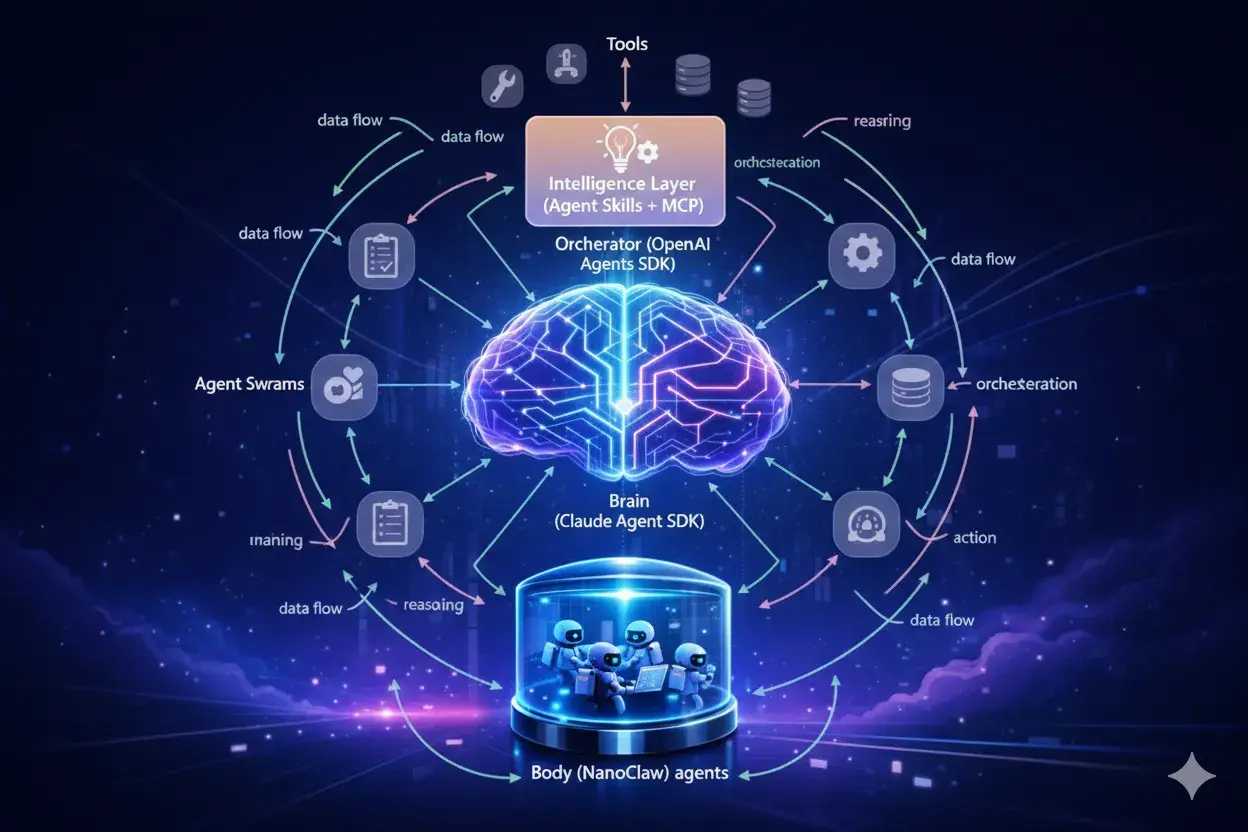
1. Executive Summary: The Era of Digital Professionals
Every profession will soon have its own Vertical AI Employee. This is not a prediction—it is an architectural inevitability. This paper provides the complete blueprint for building production-grade autonomous agents for medicine, accounting, finance, law, and HR.
The architecture is built on three core pillars:
- Body + Brain Separation: Always-on persistence (NanoClaw) paired with deep reasoning (Claude Agent SDK).
- Portable Vertical Intelligence: Industry-wide standards like Agent Skills and Model Context Protocol (MCP).
- Agents Building Agents: A recursive development loop driven by Claude Code skills.
2. The Body + Brain Architecture
Most AI products today are incomplete—they have either a body (chatbots with persistence but shallow logic) or a brain (autonomous tools that vanish when the session ends). A true Vertical AI Employee requires both.
2.1 The Body: NanoClaw
NanoClaw is a minimalist, security-hardened framework (approx. 500 lines of core TypeScript) that provides the "Body" of the employee.
- Container Isolation: Addresses CVE-2026-25253 "Agent Hijacking" by running every task in its own OS-level container.
- Multi-channel Presence: Native WhatsApp, Telegram, and Slack integration.
- Agent Swarms: The first framework to support collaborative teams of specialized Claude instances working in parallel.
- Auditability: The entire codebase can be reviewed in 8 minutes, compared to legacy systems with 430,000+ lines.
2.2 The Brain: Claude Agent SDK
The "Brain" provides the high-level reasoning. The critical differentiator here is Programmatic Tool Calling. The agent writes and executes local Python scripts to process sensitive data internally, ensuring patient records or financial statements never leave the secure container boundary. This is the gold standard for HIPAA, SOX, and zero-trust environments.
2.3 The Orchestrator: OpenAI Agents SDK
For workflows requiring routing between specialists, the OpenAI Agents SDK serves as the coordination layer, handling handoffs, guardrails, and tracing across 100+ LLMs.
3. The Portability Standard: Skills + MCP
Vertical intelligence must be portable. We achieve this through two open standards:
- Agent Skills (agentskills.io): Folders of instructions and resources (SKILL.md) that teach an agent how to think about a domain (e.g., GAAP rules, HIPAA compliance).
- Model Context Protocol (MCP): Standardized server interfaces that give an agent tools to act (e.g., FHIR clients for healthcare, QuickBooks API for finance).
4.3 Domain-Specific Intelligence Map
| Sector | Agent Skills (Think) | MCP Tools (Act) |
|---|---|---|
| Medicine | HIPAA compliance, clinical decision support | FHIR client, DICOM viewer, PubMed search |
| Accounting | GAAP/IFRS rules, SOX audit, tax code logic | QuickBooks API, Plaid feeds, SAP connector |
| Legal | Jurisdiction analysis, privilege review | LexisNexis, court filing API, document analyzer |
| HR | EEOC compliance, compensation benchmarks | Workday/BambooHR API, ATS connector |
---
5. Agents Building Agents: The Meta - Tool
NanoClaw introduces a radical "Skills Over Features" philosophy. Instead of PRs that bloat the codebase, contributors add Claude Code skills that transform the installation.
/add-hipaa-compliance: Adds compliant data handling and audit logging./add-financial-audit: Configures financial ratio MCP servers and cron tasks.
Trigger --> Transform --> Evolve --> Feedback
This creates a Recursive Development Loop: Claude Code (the agent) builds and configures NanoClaw (the Body), which runs Claude Agent SDK (the Brain), which uses skills to extend its own intelligence.
6. The Six-Layer Reference Architecture
graph TD
    A[Security Layer] --> B[Data Layer]
    B --> C[Intelligence Layer]
    C --> D[Brain Layer]
    D --> E[Orchestration Layer]
    E --> F[Body Layer]

    subgraph "The Foundation"
    A
    B
    end

    subgraph "Portable Intel"
    C
    end

    subgraph "Cognitive Core"
    D
    E
    end

    subgraph "Presence"
    F
    end
- Security: OS-level containers & Docker sandboxing (NanoClaw).
- Data: Persistent state & compliance logs (PostgreSQL/Redis).
- Intelligence: Agent Skills + MCP servers (Platform-independent).
- Brain: Claude Agent SDK reasoning engine.
- Orchestration: OpenAI Agents SDK routing & guardrails.
- Body: NanoClaw persistence & presence.
7. Implementation Roadmap
Phase 1: Foundation (Months 1–3)
- Clone NanoClaw and run
/setupvia Claude Code. - Build first 2–3 domain-specific Agent Skills (SKILL.md).
- Verify Programmatic Tool Calling against compliance requirements.
Phase 2: Intelligence (Months 4–6)
- Add OpenAI Agents SDK orchestration for multi-agent workflows.
- Set up RAG pipeline over domain corpus (LlamaIndex + Qdrant).
- Implement multi-model routing (Claude for reasoning, GPT for structure).
Phase 3: Production (Months 7–12)
- Deploy Instance-per-Tenant fleet on Kubernetes for zero-leakage security.
- Achieve HIPAA/SOC 2 certifications.
- Activate Agent Swarms for complex professional workflows.
Conclusion: Time to Build
The technology stack for the Vertical AI Employee is now clear. NanoClaw is the Body, Claude Agent SDK is the Brain, OpenAI Agents SDK is the Orchestrator, and Agent Skills + MCP are the portable intelligence.
The AI employees of medicine, accounting, law, and HR are ready to be built. Growth begins where instructions end.